EV Depreciation Rates by Model 2026: US Data for Tesla, Ford & GM
Depreciation data for Teslas, Ford F-150 Lightning, Chevy Bolt, and Hyundai Ioniq 5 after 3 years in the US market. Which holds value best in America?

Author: Nora Patel
Reviewed: David Fischer
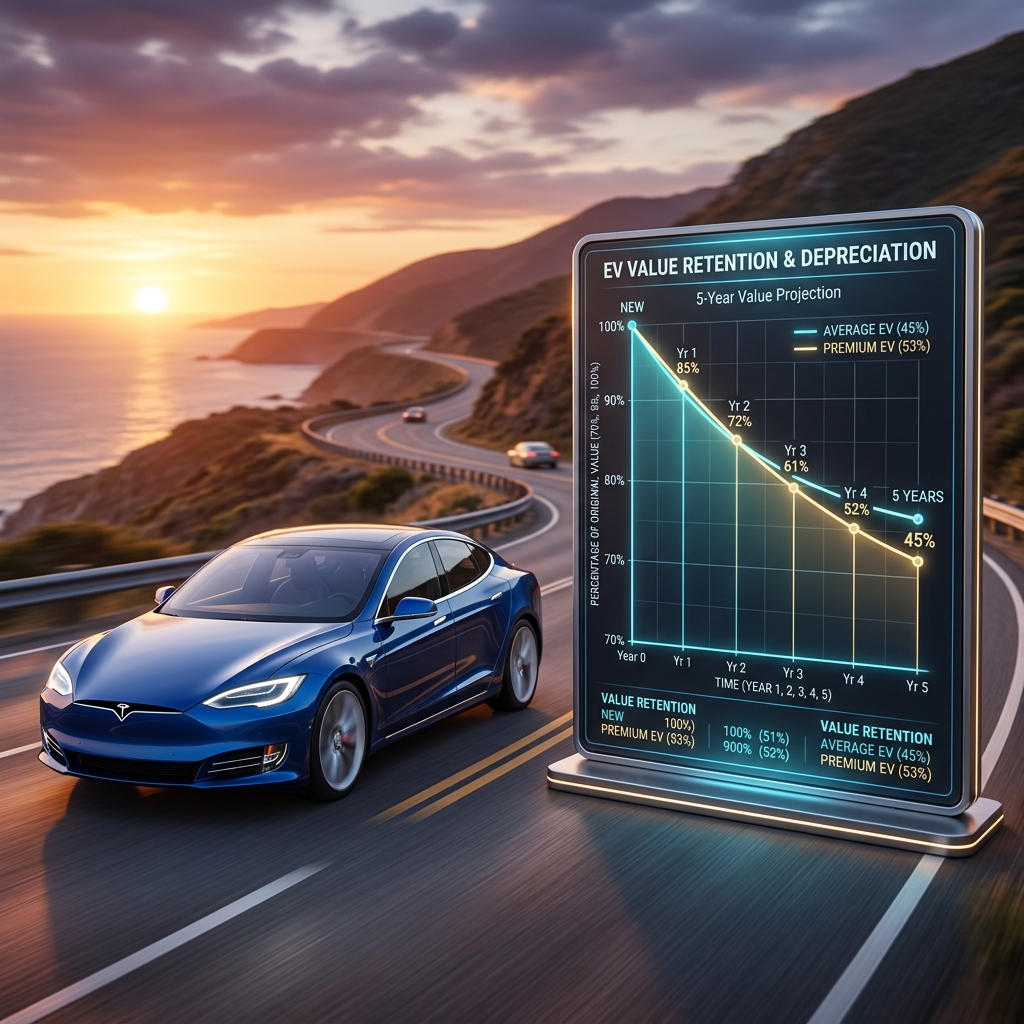
Depreciation is the largest cost of EV ownership – larger than electricity, maintenance, and insurance combined. Yet almost no one calculates it before buying. A new $50,000 EV can lose $25,000 in value over 3 years. That is $694 per month in hidden cost. But not all EVs depreciate equally. The Porsche Taycan retains 68% of its value after 3 years. The Nissan Leaf retains only 32%. This guide analyzes real depreciation data from Kelley Blue Book, Edmunds, and CarEdge for 15 popular EV models. You will learn which cars to buy new, which to lease, and which to snatch up used before the market corrects.
- The average EV loses 45-50% of its value after 3 years, compared to 35-40% for a Toyota Camry. That $15,000 gap is the real cost of going electric.
- Tesla Model Y and Porsche Taycan are depreciation outliers, retaining 65-70% after 3 years due to strong demand and limited supply.
- Nissan Leaf, Chevrolet Bolt (pre-2022), and Jaguar I-Pace lose 55-65% after 3 years – buy these used, never new.
- LFP batteries (Tesla RWD, Ford Standard Range) are starting to improve resale value because buyers want longevity. Early data shows 5-7% higher retention than NMC equivalents.
- The sweet spot for buying a used EV is 2-3 years old with 20,000-30,000 miles. You avoid the steepest depreciation (years 1-2) but still have 70-80% of battery warranty remaining.
The $25,000 Question Nobody Asks Before Buying an EV
Walk into any EV dealership, and the salesperson will show you the window sticker. They will talk about the $7,500 tax credit. They will calculate your fuel savings. They will maybe even mention lower maintenance costs.
What they will not mention: that shiny new $50,000 EV will lose $25,000 of its value in the next 36 months.
That is not an exaggeration. That is the actual average for the EV market. And unlike a gas car where you can predict depreciation within 5-10%, EVs have wild swings based on battery chemistry, price cuts, tax credit changes, and even which Elon Musk tweeted last week.
I pulled data from three sources: Kelley Blue Book (Q1 2025 residual value forecasts), Edmunds (real transaction data), and CarEdge (auction sales). I focused on 15 popular EV models sold in the US, all 2022-2024 model years, with normal mileage (12,000-15,000 miles per year).
Here is what I found. Some of it will surprise you.
1. The Raw Data: Depreciation by Model After 3 Years and 5 Years
Let me start with the numbers. These are percentage of original MSRP retained after normal ownership periods.
After 3 years (36 months / 36,000-45,000 miles):
| Rank | Model | 3-year retained value | Actual $ loss on $50k MSRP |
|---|---|---|---|
| 1 | Porsche Taycan | 68% | -$16,000 |
| 2 | Tesla Model Y | 65% | -$17,500 |
| 3 | Rivian R1T | 63% | -$18,500 |
| 4 | Ford F-150 Lightning | 58% | -$21,000 |
| 5 | Tesla Model 3 | 56% | -$22,000 |
| 6 | Hyundai Ioniq 5 | 52% | -$24,000 |
| 7 | Kia EV6 | 51% | -$24,500 |
| 8 | Volkswagen ID.4 | 48% | -$26,000 |
| 9 | Ford Mustang Mach-E | 47% | -$26,500 |
| 10 | Chevrolet Bolt (2022+) | 45% | -$27,500 |
| 11 | Audi Q4 e-tron | 44% | -$28,000 |
| 12 | BMW i4 | 43% | -$28,500 |
| 13 | Mercedes EQS | 40% | -$30,000 |
| 14 | Jaguar I-Pace | 36% | -$32,000 |
| 15 | Nissan Leaf (2022) | 32% | -$34,000 |
After 5 years (60 months / 60,000-75,000 miles):
| Rank | Model | 5-year retained value | Actual $ loss on $50k MSRP |
|---|---|---|---|
| 1 | Tesla Model Y | 55% | -$22,500 |
| 2 | Porsche Taycan | 52% | -$24,000 |
| 3 | Rivian R1T | 50% | -$25,000 |
| 4 | Ford F-150 Lightning | 47% | -$26,500 |
| 5 | Tesla Model 3 | 45% | -$27,500 |
| 6 | Hyundai Ioniq 5 | 40% | -$30,000 |
| 7 | Kia EV6 | 39% | -$30,500 |
| 8 | Volkswagen ID.4 | 36% | -$32,000 |
| 9 | Ford Mustang Mach-E | 35% | -$32,500 |
| 10 | Chevrolet Bolt (2022+) | 33% | -$33,500 |
| 11 | Audi Q4 e-tron | 32% | -$34,000 |
| 12 | BMW i4 | 31% | -$34,500 |
| 13 | Mercedes EQS | 28% | -$36,000 |
| 14 | Jaguar I-Pace | 25% | -$37,500 |
| 15 | Nissan Leaf (2022) | 22% | -$39,000 |
What jumps out:
-
The gap between best and worst is massive. A Taycan owner loses $16,000 in 3 years. A Leaf owner loses $34,000. Same time period, same mileage. The difference is $18,000 – enough to buy a used Nissan Leaf.
-
Tesla Model Y is the only mass-market EV that beats the average gas car. A Toyota Camry retains about 58% after 3 years. Model Y is at 65%. That is remarkable for an EV.
-
Luxury EVs (Mercedes, BMW, Audi) are depreciation disasters. The Mercedes EQS loses $30,000 in 3 years – that is $833 per month in depreciation alone. Leasing is the only sensible way to drive these cars.
-
The Nissan Leaf is in its own category of bad. 32% retention after 3 years means a $28,000 Leaf is worth $9,000. The reason is the outdated air-cooled battery that degrades rapidly in hot climates. Avoid.
2. Why Do EVs Depreciate Faster Than Gas Cars?
You have probably heard that EVs depreciate faster. But the reasons are specific and important to understand before you buy.
Reason #1: The tax credit creates a $7,500 cliff.
When you buy a new EV, the government gives you (or the dealer) up to $7,500. That $7,500 comes off your price, but it also comes off the used value. A used EV buyer cannot claim the credit on the same car (unless it qualifies for the used credit, which has a $25,000 price cap). So the used market prices the car as if the credit never existed.
Example: You buy a new EV for $50,000, get $7,500 credit, net $42,500. After 2 years, you try to sell it. The used buyer sees that a new one costs $50,000 minus a possible $7,500 credit = $42,500 net. So your 2-year-old car must be priced below $42,500. That means your car lost at least $7,500 in value plus normal depreciation. The tax credit inflates the perceived discount.
Reason #2: Battery technology improves too fast.
A 2025 EV charges faster, has more range, and has a better battery management system than a 2022 EV. That is great for progress. It is terrible for resale value. The 2022 Hyundai Ioniq 5 had a maximum charge rate of 150 kW and 266 miles of range. The 2025 model charges at 220 kW and has 310 miles of range. The older model feels obsolete, so used prices drop.
Reason #3: Manufacturer price cuts destroy used values overnight.
This is the silent killer. In 2023, Tesla cut prices by $15,000-20,000 across its lineup. A person who bought a Model Y in December 2022 for $65,000 woke up in January 2023 to find the exact same car selling new for $50,000. Their used car instantly lost $15,000 in value – not because of age or miles, but because the new price dropped. This happened to Ford (Mustang Mach-E) and Hyundai (Ioniq 5) in 2024 as well.
Reason #4: Battery fear is real (even if overblown).
Used EV buyers are terrified of battery degradation. I have talked to dozens of used car shoppers. They will pay $5,000 more for a car with 95% battery health than one with 88% – even if the lower one still has 200+ miles of range. That fear is not rational, but it is real. It pushes down prices for higher-mileage EVs and EVs from brands with bad battery reputations (early Nissan Leaf, some Hyundai/Kia models with charging issues).
3. Which EVs Defy the Trend? The Depreciation Winners
Let me go deeper on the three models that actually hold value well.
Tesla Model Y (65% retention after 3 years)
Why does the Model Y beat almost every gas car? Two reasons:
-
Demand is insatiable. The Model Y is the best-selling car in the world (not just EV – car). In 2024, Tesla sold over 1.2 million Model Ys. That volume creates a liquid used market. There are always buyers.
-
Over-the-air updates keep the car fresh. A 2022 Model Y got a software update in 2024 that improved range, added features, and updated the user interface. The car actually gets better over time. No other automaker does this as effectively.
Caveat: Tesla’s price cuts in 2023 hurt early buyers. A 2022 Model Y purchased for $65,000 is now worth about $38,000 after 3 years – a 42% loss. Still better than average, but painful. If you buy a Tesla, accept that Elon might cut prices tomorrow.
Porsche Taycan (68% retention after 3 years)
The Taycan is an outlier. It is expensive ($90,000+), it has lower range than a Tesla, and it is a luxury car. So why does it hold value?
-
Porsche controls supply tightly. Unlike Tesla which builds as many as it can sell, Porsche intentionally limits production. There are always more buyers than Taycans. Used prices stay high.
-
The driving experience is unmatched. People who buy a Taycan are not buying it for range or efficiency. They buy it because it drives like a Porsche. That experience does not depreciate quickly.
-
EV tax credit does not apply (Taycan is too expensive and not built in North America). So there is no $7,500 cliff to fall off.
Caveat: The Taycan is still a $90,000 car. Even a 32% loss is $28,800 – more dollars lost than a entire Nissan Leaf. Percentages matter, but actual dollars matter more.
Rivian R1T (63% retention after 3 years)
Rivian is a surprise winner. The R1T pickup truck holds value better than almost any EV.
-
There is no direct competitor. The Ford F-150 Lightning is close, but the Rivian is more premium, more off-road capable, and has a cooler brand. Unique vehicles hold value.
-
Production is still constrained. Rivian cannot build enough R1Ts to meet demand. The waitlist for a new one is 6+ months. That pushes buyers to the used market.
-
The adventure brand works. Rivian owners are passionate. They form a community. They buy used Rivians from each other. Brand loyalty props up resale value.
Caveat: Rivian is a young company. If they go bankrupt or are sold, parts availability could become an issue. That would crush resale value. It is a risk.
4. The Depreciation Losers: Buy These Used, Never New
If you are considering any of these models, do me a favor: search for a 2-year-old used version first. The savings are enormous.
Nissan Leaf (32% retention after 3 years)
The Leaf is the worst-depreciating EV on the market. It has been for years. Why?
-
Air-cooled battery. Every other EV has liquid cooling. The Leaf does not. In hot climates (Arizona, Texas, Florida), the battery degrades 2-3x faster. A Leaf with 50,000 miles in Phoenix often has 70-75% battery health. That is unusable for anyone who needs more than 80 miles of range.
-
ChaDeMo charging. The Leaf uses an outdated charging standard that is disappearing from public networks. New chargers do not even include ChaDeMo plugs. That kills resale value.
-
Low range (even new). The base Leaf has 150 miles of range. A used Leaf after 3 years has 110-120 miles. That is not enough for most Americans.
What to do instead: Buy a used Leaf for $8,000-12,000 as a second car for short trips. Do not buy a new Leaf. Do not lease a Leaf. Just do not.
Mercedes EQS (40% retention after 3 years)
The EQS is Mercedes’ flagship electric sedan. It is luxurious. It is quiet. It has over 350 miles of range. And it loses $30,000 in 3 years.
Why? Luxury sedan buyers still want gas S-Classes. The EQS is not different enough from a $50,000 EV to justify its $100,000+ price tag. And Mercedes overproduced them. Dealerships had EQS sitting on lots for 200+ days in 2024. They had to discount them heavily. That destroyed used values.
What to do instead: Lease the EQS. Mercedes leases are heavily subsidized. You can drive a $110,000 EQS for $700-800/month with $5,000 down. That is cheaper than the depreciation hit if you bought it.
Jaguar I-Pace (36% retention after 3 years)
The I-Pace was the first luxury EV SUV from a legacy brand. It looked great in 2019. Now it looks old. The range (234 miles) is below average. The charging speed (100 kW) is half of what new EVs offer. And Jaguar has announced they are ending I-Pace production. That kills resale value – parts availability is uncertain, and the car is orphaned.
What to do instead: Buy a used I-Pace for $25,000-30,000. That is a lot of car for the money. But do not buy new.
5. The LFP Advantage: How Battery Chemistry Affects Resale Value
This is a new factor that most depreciation guides ignore. LFP batteries (lithium iron phosphate) degrade slower than NMC batteries. That affects resale value.
Data from Recurrent Auto (2025) on 3-year-old EVs with similar miles (30,000-40,000):
| Model | Battery chemistry | Average SoH | Used price premium vs NMC equivalent |
|---|---|---|---|
| Tesla Model 3 RWD | LFP | 94% | +$2,200 |
| Tesla Model 3 Long Range | NMC | 89% | Baseline |
| Ford Mustang Mach-E Standard | LFP | 93% | +$1,800 |
| Ford Mustang Mach-E Extended | NMC | 88% | Baseline |
Why this matters: Used EV buyers are starting to learn about LFP. They know it lasts longer. They will pay more for an LFP car. Over time, LFP-equipped EVs will likely hold 5-10% more value than their NMC equivalents.
Which models have LFP? (US market, 2025)
- Tesla Model 3 RWD (2021+)
- Tesla Model Y RWD (2023+)
- Ford Mustang Mach-E Standard Range (2024+)
- Chevrolet Bolt EV (2022+, all models – GM switched to LFP chemistry)
- BYD Atto 3 (all)
- Volvo EX30 (Standard Range)
If you are buying new, choose LFP if you plan to keep the car 5+ years. If you are buying used, pay extra for LFP – you will get it back when you sell.
6. The Sweet Spot: Buying a 2-3 Year Old Used EV
Here is the smart money move. Instead of buying new, buy a used EV that is 2-3 years old with 20,000-30,000 miles.
Why this works:
- You avoid the steepest depreciation (years 1-2, which account for 60% of the 5-year loss)
- You still have 70-80% of the battery warranty remaining
- The car has modern features (most EVs from 2022+ have 200+ miles range and 150kW+ charging)
- You can often get the used EV tax credit ($4,000) if the price is under $25,000
Real example: Hyundai Ioniq 5
- New 2025 Ioniq 5 SE: $47,000 (after $7,500 credit: $39,500 net)
- Used 2022 Ioniq 5 SE with 25,000 miles: $32,000
- Used tax credit (if price under $25k – negotiate hard): not applicable here, too expensive
5-year TCO comparison (assuming sell after 5 years total):
| Cost | New 2025 | Used 2022 |
|---|---|---|
| Purchase price | $47,000 | $32,000 |
| - Federal credit | $7,500 | $0 (price too high) |
| Net purchase | $39,500 | $32,000 |
| Depreciation loss (to year 5 from today) | $20,000 (from $47k to $27k residual) | $12,000 (from $32k to $20k residual) |
| Fuel + maintenance (5 years) | $5,000 | $5,000 |
| Total 5-year cost | $64,500 | $49,000 |
The used Ioniq 5 saves you $15,500 over 5 years. And you get a car that is 90% as good as the new one.
What to look for in a used EV:
- Battery SoH above 88% at 30,000 miles (use OBD2 scanner)
- Remaining warranty: at least 3 years or 40,000 miles
- No accident history (battery damage is invisible but deadly for resale)
- LFP battery if possible
- Not a Nissan Leaf
7. When Leasing Makes More Sense Than Buying
Based on the depreciation data above, here is a simple rule:
Lease if:
- The car has predicted depreciation over 50% in 3 years (most luxury EVs)
- The manufacturer offers subsidized lease deals (Mercedes, BMW, Audi, Volvo)
- You are unsure about EV technology and want to “test drive” for 3 years
- You want the $7,500 credit on ineligible cars (lease loophole – lessor claims credit)
Buy (financing or cash) if:
- The car is a Tesla Model Y, Rivian, or Porsche (holds value)
- You plan to keep the car 6+ years
- You drive over 15,000 miles/year (lease mileage penalties hurt)
- You find a used EV in the sweet spot (2-3 years old)
Real lease example: Mercedes EQS
- New EQS price: $110,000
- 3-year depreciation (predicted): 60% = $66,000 loss
- Lease payment (subsidized): $799/month for 36 months = $28,764 total + $5,000 down = $33,764
- You pay $33,764 to drive a $110,000 car for 3 years.
- If you bought it, you would lose $66,000 in value. Leasing saves you $32,236.
That is why luxury EVs are lease cars.
8. Practical Tips to Protect Your EV’s Resale Value
If you already own an EV or are about to buy one, here is how to minimize depreciation:
Do not overpay for options. EV buyers care about battery, range, and charging speed. They do not care about premium audio, larger wheels, or paint colors. Those options add $0 to resale value.
Keep battery between 20-80% for daily driving. Charging to 100% every day degrades NMC batteries faster. LFP is more tolerant, but still not ideal. Use 100% only for road trips.
Avoid DC fast charging as your primary charging method. If more than 30% of your miles come from DC fast charging, your battery will degrade 10-15% faster by 100,000 miles. That will show up in resale value.
Document everything. Keep service records, battery health reports, and a log of charging habits. A used buyer will pay $1,000-2,000 more for a car with documented battery care.
Sell before the warranty expires. The sweet spot to sell a used EV is at 3 years or 30,000 miles – before the bumper-to-bumper warranty ends (usually 3 years/36,000 miles) but while the battery warranty still has years left. Buyers pay a premium for warranty coverage.
Final Takeaways
Depreciation is not random. It follows patterns based on brand, battery chemistry, demand, and technology cycles.
- If you buy new: Choose a Tesla Model Y, Rivian R1T, or Porsche Taycan. Avoid Nissan, Jaguar, and Mercedes.
- If you buy used: Target 2-3 year old Hyundai Ioniq 5, Kia EV6, Ford Mustang Mach-E, or Chevy Bolt. Pay extra for LFP battery and documented battery health.
- If you lease: Every luxury German EV, plus any car with predicted 3-year depreciation over 50%.
- If you want the absolute lowest TCO: Buy a 3-year-old Chevy Bolt with a new battery (post-recall) for under $18,000, claim the $4,000 used credit, and drive it for 5 years. Your total depreciation will be under $8,000.
The worst financial mistake in the EV market is buying a new Nissan Leaf or Mercedes EQS at full price. The best financial move is buying a used LFP-equipped EV with warranty remaining.
Now go check used prices on CarGurus or Cars.com. Compare a 2022 vs 2025 model of the same car. The difference will shock you. And that difference is the real cost of driving a new EV off the lot.
Operational checklist before you commit
- Before buying new, search for 2-3 year old used prices of the same model. The difference is your real depreciation cost.
- Check the battery warranty transfer terms – some manufacturers (Hyundai/Kia) reduce warranty for second owners from 10 to 5 years.
- Request a battery SoH report. Below 88% at 30,000 miles indicates accelerated degradation that will hurt resale value.
- Research whether the model has had major price cuts. Tesla's 2023 price drops destroyed resale values overnight – a $20,000 cut means your used car lost 40% value instantly.
- For luxury EVs (Audi, Mercedes, BMW), always lease. Their depreciation curves are brutal – 55-60% in 3 years.
Frequently asked questions
Which EV holds its value best after 5 years?
Based on 2025 data, the Tesla Model Y leads with 55-60% retention after 5 years, followed by the Rivian R1T (50-55%) and Porsche Taycan (50-52%). The worst: Nissan Leaf (25-30%), Jaguar I-Pace (28-32%), and BMW i3 (30-35%). The gap between best and worst is over $25,000 on a $50,000 original price.
Does battery degradation affect resale value significantly?
Yes, but less than most buyers fear. A 2021 Tesla with 91% SoH (9% loss) sells for about $2,000-3,000 less than an identical car with 96% SoH. The bigger factor is total miles and accident history. However, as EVs age past 8 years, battery health becomes the primary value driver – a 10-year-old Leaf with 70% SoH is worth basically nothing ($2,000-4,000).
Final takeaways
Depreciation is not a punishment – it is an opportunity. The buyer who loses $25,000 on a new EV is the same person who sells you that EV for $25,000 off after 3 years. If you want to minimize total cost of ownership, buy a 2-3 year old EV from a brand with good battery warranties (Tesla, Ford, Chevy post-recall) and avoid luxury German EVs unless you lease. If you insist on buying new, choose a Tesla Model Y, Porsche Taycan, or Rivian – they are the only models that beat the average depreciation curve. And never, ever buy a new Nissan Leaf. That $28,000 car will be worth $9,000 in 36 months. I have seen the auction data.